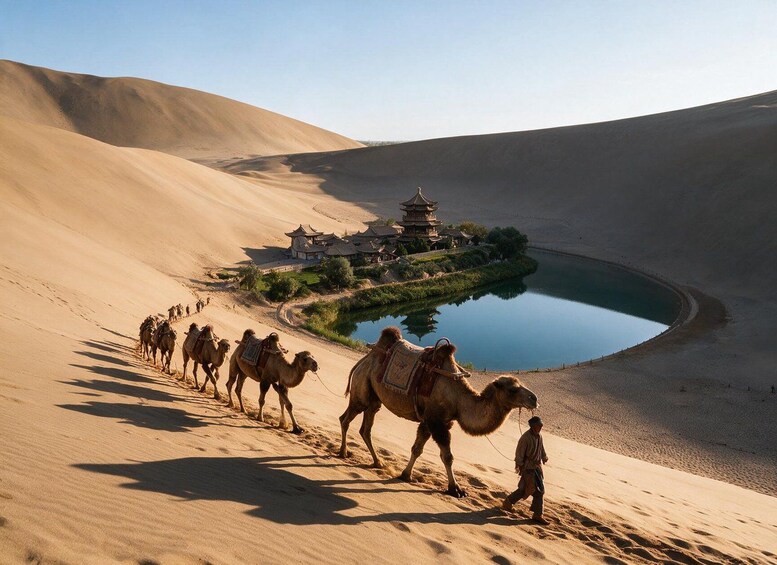
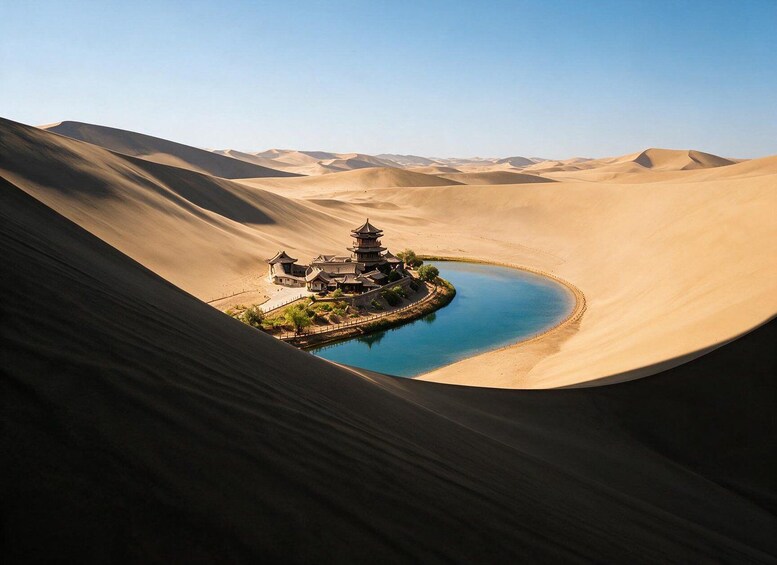
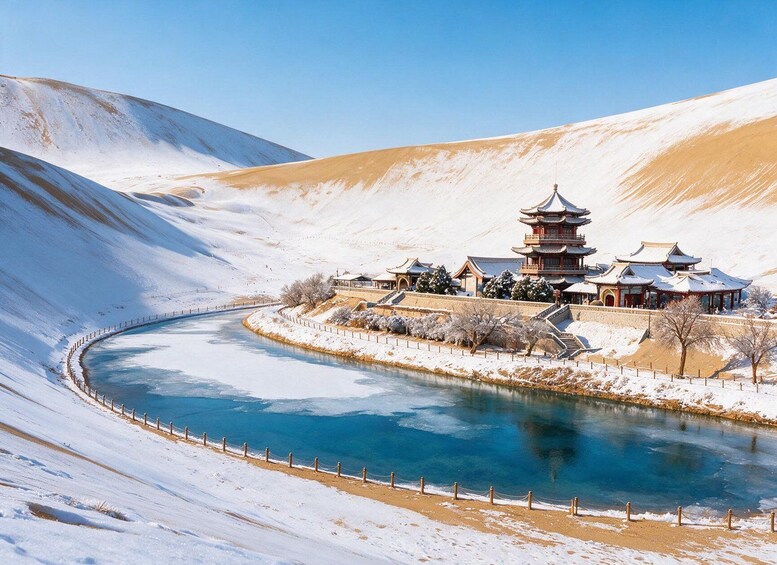
There are few places on earth where water and desert argue so beautifully. In Dunhuang, Gansu, China, the Mingsha dunes rise over a hundred meters and run for miles in long sculpted waves, and at their foot a crescent of spring water holds its ground, blue-green against amber, calm against the constant drift of sand. From the ridge the view opens into pure geometry: ridge after ridge curling like frozen silk, their sunlit sides glowing saffron and their shadowed sides deepening to violet, while the lake below sits perfectly still, fringed with green reeds and framed by one flawless arc of sand. The scale strikes you first, then the silence — no traffic, no city, only wind pushing grains in a long hiss, and sometimes that strange low hum the dunes are named for, a sound like a cello bowed far away. Light rewrites the place hour by hour: at dawn the sand is cool and mauve and the lake is silver; at midday the dunes burn white-gold and shadows turn hard and blue; in the final hour the whole basin becomes bronze, the camel line turns into a row of dark beads on the crest, and the water catches fire. After dark the desert turns into an observatory, the Milky Way arching over the ridges while the lake keeps a smaller, softer copy of the same sky. Photographers wait on the crest for the twenty minutes when the light is thickest, and nobody speaks; the wind moves, the reeds bend, the crescent holds its shape, and the desert feels older than any story told about it.